Commercial Siding Replacement Cost Per Square Foot in Georgia

If you’re a property manager or commercial building owner in Metro Atlanta trying to budget for a siding replacement project, you’ve probably discovered that most online pricing guides are frustratingly vague. National averages don’t account for Georgia’s labor market, climate requirements, or the specific challenges of commercial properties. The truth is that commercial siding replacement cost per square foot Georgia typically ranges from $6 to $23 per square foot installed, depending on your material choice, building complexity, and property type. For a 10,000 square foot commercial building, that translates to a total project cost between $60,000 and $230,000. That’s a wide range—and the variables matter significantly when you’re presenting numbers to ownership groups or HOA boards. This guide breaks down actual pricing by material type and building category specific to the Metro Atlanta market, explains what drives costs up or down, and covers the insurance claim angle that could potentially cover 80-100% of your project if storm damage is involved.
Average Commercial Siding Replacement Cost Per Square Foot Georgia Property Owners Should Expect
Let’s start with the numbers that matter most. In Metro Atlanta and throughout Georgia, commercial siding replacement costs break down into material costs and labor costs, both of which run slightly higher than national averages due to our competitive construction labor market and climate-specific material requirements. Understanding these baseline figures helps property managers and building owners establish realistic budget expectations before soliciting contractor bids. When calculating the commercial siding replacement cost per square foot Georgia businesses will pay, you need to account for several pricing tiers based on material selection and installation complexity.
Material costs per square foot installed:
- Vinyl commercial siding: $4–$8 per square foot
- Fiber cement siding (James Hardie): $8–$14 per square foot
- Metal panel systems: $10–$18 per square foot
- Insulated composite siding: $12–$20 per square foot
Labor costs in Metro Atlanta typically add $2–$5 per square foot on top of materials, depending on building height, accessibility, and project complexity. Multi-story buildings requiring scaffolding or boom lifts will fall on the higher end of that range. The skilled labor shortage affecting the construction industry nationwide has hit Georgia particularly hard, with experienced siding installers commanding premium wages in the competitive Metro Atlanta market.
For a typical 5,000 square foot commercial building, you’re looking at total project costs ranging from $30,000 for basic vinyl to $115,000 for premium metal panel systems with complex installation requirements. A mid-range fiber cement installation on that same building typically falls between $50,000 and $95,000. These figures represent installed costs including tear-off, disposal, and standard trim work, though substrate repairs and unusual configurations may add to the final total.
Georgia costs differ from national averages for several reasons. Our humid subtropical climate demands moisture-resistant materials and proper ventilation behind the siding. The Metro Atlanta construction boom has pushed skilled labor rates above the national median. And Georgia’s building codes require specific wind and impact ratings in many jurisdictions, particularly after recent hurricane seasons pushed standards higher. Property owners should also factor in the extended installation season Georgia enjoys—our mild winters allow year-round exterior work, which can actually benefit scheduling flexibility and pricing negotiations during slower months.
Cost Factors That Impact Your Commercial Siding Project

The price per square foot you’ll actually pay depends heavily on project-specific variables. Understanding these factors helps you develop realistic budget projections and avoid surprise costs mid-project. A qualified commercial siding contractor Atlanta will assess all these elements during their initial evaluation to provide accurate estimates.
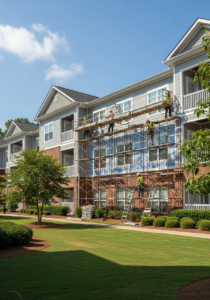
Building height and accessibility represent the most significant cost variable after material selection. Single-story warehouses and retail buildings allow crews to work from standard ladders and ground-level staging. Multi-story office buildings and apartment complexes require scaffolding systems or aerial lifts, adding 15–25% to labor costs. Buildings with limited access points, adjacent structures, or parking lot constraints add additional complexity and time. Properties located in busy commercial districts may require traffic control measures or after-hours work to minimize disruption to neighboring businesses.
Existing siding removal and disposal adds $1–$2 per square foot to your project. Older buildings with multiple layers of siding, lead paint concerns, or asbestos-containing materials require specialized removal procedures that can push tear-off costs to $3–$4 per square foot. Your contractor should include disposal fees in this estimate—Georgia landfills charge commercial construction debris rates that have increased significantly over the past several years. Buildings constructed before 1980 warrant particular attention, as they may contain hazardous materials requiring licensed abatement contractors and EPA-compliant disposal methods.
Substrate repairs often emerge as the biggest budget surprise. Once the old siding comes off, contractors frequently discover rotted sheathing, damaged house wrap, or structural issues hidden for years. Budget 10–15% contingency for substrate repairs on buildings over 20 years old. When we provide siding replacement services, we always conduct a thorough initial assessment and provide transparent estimates for likely underlying repairs. Common substrate issues in Georgia include moisture damage from failed flashing, termite damage to wood sheathing, and deteriorated building paper that allowed water intrusion over extended periods.
Permits, inspections, and code compliance vary significantly across Georgia municipalities. Cobb County, Gwinnett County, and the City of Atlanta all have different permit fee structures and inspection requirements. Budget $500–$2,500 for permits depending on project scope and location. Some jurisdictions require energy compliance documentation for commercial exterior envelope work, while others have expedited commercial permit tracks that can reduce project timelines. Your contractor should handle permit applications as part of their scope of work, but understanding the local requirements helps you anticipate timeline impacts.
Weather and seasonal timing also influence project costs and scheduling. While Georgia’s climate allows year-round installation, extreme summer heat can slow production and increase crew fatigue, potentially extending project timelines. Spring and fall typically offer optimal working conditions, though these seasons also represent peak demand periods when contractor availability may be limited.
Commercial Siding Material Options and Price Comparison for Georgia Buildings
Choosing the right material for your commercial property requires balancing upfront costs against longevity, maintenance requirements, and aesthetic standards. Here’s how the main options compare for Georgia commercial applications, with particular attention to how each performs in our challenging climate conditions:
| Material | Cost per Sq Ft (Installed) | Lifespan | Best For | Georgia Considerations |
|---|---|---|---|---|
| Vinyl Commercial Grade | $4–$8 | 15–20 years | Budget-conscious retail, small offices | Fades faster in Georgia sun; choose higher-grade for south-facing walls |
| Fiber Cement (James Hardie) | $8–$14 | 30–50 years | Multifamily, professional offices, HOA properties | Excellent moisture and termite resistance; ideal for Georgia climate |
| Metal Panel Systems | $10–$18 | 40–60 years | Warehouses, industrial, storm-prone areas | Best wind and hail resistance; energy-efficient in Georgia heat |
| Insulated Composite | $12–$20 | 25–35 years | Climate-controlled buildings, cold storage | Reduces cooling costs by 10–15% in Georgia summers |
Vinyl commercial siding offers the lowest upfront cost but has the shortest lifespan, particularly in Georgia’s heat and UV exposure. It works well for retail strip centers and smaller office buildings where aesthetics are secondary to budget. However, you’ll likely need replacement again in 15–20 years. Commercial-grade vinyl has improved significantly in recent years, with thicker profiles and better UV stabilizers than residential products, but it still cannot match the longevity of fiber cement or metal alternatives. Color selection matters—darker colors absorb more heat and may warp or distort on south-facing walls during Georgia’s intense summer months.
Commercial fiber cement siding Georgia properties benefit from most (James Hardie being the dominant brand) represents the best value proposition for most Georgia commercial properties. The 30–50 year lifespan, combined with fire resistance, termite immunity, and excellent moisture performance, makes it the preferred choice for apartment complexes, professional offices, and HOA-managed properties requiring long-term durability. James Hardie’s HZ10 formulation was specifically engineered for humid climates like Georgia’s, incorporating moisture-resistant technology that prevents swelling, cracking, and delamination common with lesser products. The material accepts paint well and can be refinished to update aesthetics without full replacement, extending its effective service life even further.
Metal panel systems offer the highest durability and are particularly appropriate for warehouses, industrial facilities, and any buildings in storm-prone areas. The superior wind and impact ratings can reduce insurance premiums and minimize future storm damage restoration needs. Modern metal panel systems feature advanced coatings that resist fading, chalking, and corrosion far better than products from even a decade ago. Standing seam profiles provide excellent water-shedding capability, while insulated metal panels combine exterior cladding with thermal performance in a single installation step. Industrial building siding prices using metal panels typically deliver the lowest total cost of ownership when maintenance savings and lifespan are factored into the analysis.
Insulated composite siding represents a newer category offering excellent thermal performance integrated directly into the siding profile. These products work particularly well for climate-controlled buildings, refrigerated warehouses, and properties where energy efficiency directly impacts operating costs. The foam backing provides continuous insulation that eliminates thermal bridging common with traditional siding installations over wood or metal studs.
Siding Costs by Commercial Property Type in Georgia

Different commercial property types have distinct cost profiles based on their typical configurations, aesthetic requirements, and operational constraints. Here’s what Georgia property managers should expect when budgeting for siding replacement on various building categories:
Retail strip centers typically cost $6–$12 per square foot installed. These projects often require integration with existing signage, consistent aesthetic standards across multiple tenant spaces, and coordination around business hours. The front-facing portions frequently use higher-grade materials while rear and side walls may use basic vinyl or metal. Tenant coordination presents unique challenges—you’ll need to communicate project timelines clearly, address concerns about customer access during construction, and potentially negotiate temporary rent adjustments for units experiencing significant disruption. Many retail property managers schedule major siding work during slower business seasons or coordinate with planned tenant turnover periods.
Apartment complexes and multifamily properties generally fall in the $5–$10 per square foot range, making multifamily siding cost per unit calculations important for budget planning. Bulk pricing becomes available for communities with 50+ units, and phased replacement programs can spread costs across multiple budget cycles. Property managers can often negotiate 10–15% discounts for full-community contracts with flexible scheduling. Fiber cement dominates this segment due to its longevity and professional appearance. For a typical 200-unit apartment community, total siding replacement might range from $400,000 to $800,000 depending on building configurations and material selections. Many property management companies amortize these costs over the expected material lifespan when calculating per-unit impact on operating budgets.
Warehouse siding replacement cost represents the most cost-effective commercial siding projects at $4–$8 per square foot. Single-story construction eliminates scaffolding costs. Simple wall configurations without extensive trim work speed installation. Metal panel systems dominate this category due to durability and minimal maintenance requirements. Warehouse projects also benefit from fewer aesthetic constraints—functionality and weather protection take priority over architectural appeal. Many warehouse owners choose to replace siding in conjunction with roof work, achieving economies of scale by mobilizing equipment and crews for comprehensive exterior envelope improvements.
Office buildings command premium pricing at $8–$15 per square foot. Professional-grade materials, detailed trim work, and aesthetic requirements drive higher costs. Multi-story access needs and occupied-building logistics add complexity. When these buildings are part of larger commercial exteriors, we often coordinate siding with commercial roofing and exterior services for comprehensive envelope restoration. Class A office properties in competitive markets may justify premium materials like architectural metal panels or high-end fiber cement systems with custom color matching to maintain market positioning and tenant appeal.
Mixed-use developments present unique challenges combining retail, office, and residential components with potentially different material specifications for each use type. These projects require careful coordination between ownership entities, property managers, and contractors to ensure cohesive aesthetic outcomes while meeting the functional requirements of each building section.
Insurance Claims and Storm Damage Considerations for Commercial Siding
Here’s what most pricing guides don’t tell you: if your commercial siding damage resulted from hail, wind, or other covered perils, your commercial property insurance may cover 80–100% of the replacement cost. Georgia’s severe storm seasons—particularly the spring hail events and hurricane-season wind events—frequently cause siding damage that qualifies for full replacement under commercial policies. Understanding how to navigate the insurance claim process can transform a major capital expenditure into a covered restoration project.
Common covered damage includes:
- Hail dents and cracks in vinyl or fiber cement siding
- Wind-driven debris impact damage
- Lifted, torn, or missing siding panels from straight-line winds
- Water intrusion damage resulting from storm-caused breaches
- Damage from fallen trees or limbs during storm events
- Siding deterioration accelerated by storm-caused moisture intrusion
Documentation requirements are critical for successful commercial claims. You’ll need pre-loss photographs (review your property management files), a detailed contractor damage assessment with measurements and affected areas identified, and coordination with your insurance adjuster’s inspection schedule. Professional documentation often makes the difference between a partial repair settlement and full replacement approval. Experienced contractors understand what adjusters look for and can present damage evidence in formats that support claim approval.
Policy type matters significantly. Replacement cost value (RCV) policies pay the full cost to replace damaged siding with equivalent materials. Actual cash value (ACV) policies deduct depreciation, potentially leaving significant out-of-pocket costs. Review your commercial property policy or consult your insurance agent before filing. Many commercial property owners don’t realize their policy includes matching provisions that may require replacement of undamaged siding when damaged sections cannot be reasonably matched with available products.
Claim timing and process considerations affect both approval likelihood and project scheduling. Most policies require prompt notification of damage—typically within 30–60 days of the event. However, some storm damage manifests gradually, and policies generally allow claims for damage discovered later if it clearly resulted from a specific covered event. Working with a contractor experienced in insurance restoration ensures proper damage documentation and realistic scope development that adjusters can approve without extensive negotiation.
Pro Roofing & Siding works directly with commercial insurance adjusters throughout Metro Atlanta. We provide detailed damage documentation, meet adjusters on-site, and advocate for full replacement when damage patterns support it. Many of our commercial clients have had storm-related siding projects approved at little to no out-of-pocket cost beyond their deductible.
How to Get Accurate Pricing for Your Georgia Commercial Property
Online siding calculators consistently underestimate commercial projects by 20–40%. They use national averages, assume single-story residential configurations, and ignore the complexities that drive commercial costs. Getting accurate numbers for commercial siding replacement cost per square foot Georgia requires professional assessment by qualified contractors familiar with local market conditions and building code requirements.
What to expect during a professional commercial siding inspection:
- Complete measurement of all exterior wall surfaces including soffits and trim
- Assessment of existing siding condition and underlying substrate
- Identification of access challenges, height requirements, and staging needs
- Documentation of any visible storm damage or deterioration
- Discussion of material options appropriate for your property type
- Written estimate with itemized costs and project timeline
- Review of permit requirements for your specific jurisdiction
- Assessment of potential insurance claim viability if storm damage exists
Questions to ask commercial siding contractors:
- Are you licensed and insured for commercial work in Georgia? (Verify current licensure)
- What are your liability and workers’ compensation insurance minimums?
- Do you provide written warranties on both materials and labor?
- Have you completed similar projects on comparable commercial properties?
- Will you coordinate directly with our insurance company if this is a claim?
- Can you provide references from other commercial property managers?
- How do you handle unexpected substrate damage discovered during tear-off?
- What is your typical timeline for a project of this scope?
Red flags to watch for: contractors who provide quotes without visiting the property, pricing dramatically below market rates (often indicating corners will be cut), pressure to sign immediately, and reluctance to provide license numbers or insurance certificates. Also be cautious of contractors who cannot provide local commercial references or who seem unfamiliar with Georgia building codes and permit requirements.
Getting multiple bids helps establish reasonable pricing ranges, but be cautious about simply selecting the lowest bidder. Compare scope details carefully—low bids often exclude items that other contractors include, creating apparent savings that disappear when change orders accumulate. Request detailed line-item breakdowns that allow true apples-to-apples comparisons between competing proposals.
Budgeting and Financing Your Commercial Siding Project
Smart commercial property owners treat siding replacement as a planned capital expenditure rather than an emergency repair. Siding should appear as a 5–7 year budget line item based on the expected lifespan of your current installation and visible deterioration patterns. Proactive planning allows time for proper contractor vetting, optimal seasonal scheduling, and reserve accumulation or financing arrangement.
ROI considerations beyond aesthetics:
- Property value: New siding increases commercial property values by 3–7% according to industry studies
- Reduced maintenance: Eliminates annual painting, caulking, and repair costs
- Tenant retention: For multifamily properties, exterior appearance impacts renewal decisions
- Energy efficiency: Modern insulated siding options reduce HVAC costs 10–15%
- Insurance premiums: Impact-resistant materials may qualify for premium discounts
- Competitive positioning: Updated exteriors support premium rental rates and attract quality tenants
- Reduced liability: Deteriorated siding that allows water intrusion can lead to mold issues and potential tenant claims
Phased replacement strategies work well for large properties or HOA communities with budget constraints. You might replace the most visible or most deteriorated sections in year one, then complete remaining buildings over subsequent budget cycles. This approach maintains community appearance standards while spreading capital requirements. Phasing also allows property managers to evaluate contractor performance on initial phases before committing to full-property contracts.
Financing options for commercial siding projects include traditional commercial loans, equipment financing structures, and property improvement lines of credit. Some contractors offer financing programs that allow manageable monthly payments over 3–7 year terms. For income-producing properties, financing costs may be tax-deductible as operating expenses, though property owners should consult their accountants for specific guidance.
Timing your project strategically can reduce costs. Georgia’s commercial construction market slows during late fall through early spring (November through February), when contractors often offer more competitive pricing and faster scheduling. Summer projects—our busiest season—typically command premium rates and longer lead times. If your project isn’t urgent, scheduling for off-season installation can save 5–10% on labor costs while potentially securing more experienced crews who might be assigned to premium projects during peak season.
Why Choose Pro Roofing & Siding for Commercial Siding in Georgia?
Pro Roofing & Siding brings the same professionalism and expertise to commercial siding projects that has earned us a 4.8-star rating with 282+ reviews from property owners across Metro Atlanta. As a GAF Master Elite certified contractor—a designation held by only 3% of roofing contractors nationwide—we maintain the highest standards for materials, installation, and customer service.
What sets us apart for commercial clients:
- Dedicated commercial project management with single-point accountability
- Full documentation for property management files and ownership reporting
- Insurance claim expertise—we work directly with adjusters to maximize approvals
- Flexible scheduling around tenant operations and business hours
- Comprehensive warranties backed by our long-standing Metro Atlanta reputation
- Experience with HOA compliance requirements and architectural review processes
- In-depth knowledge of Georgia building codes and local permit requirements
- Established relationships with premium material suppliers ensuring product availability
We serve property managers, building owners, and HOA boards throughout Cobb County, Cherokee County, Gwinnett County, and the greater Metro Atlanta region. From warehouse siding replacement to apartment complex renovations to professional office upgrades, our team delivers on time and on budget. Our commercial portfolio includes retail centers, industrial facilities, multifamily communities, and professional office buildings representing millions of square feet of completed installations.
Frequently Asked Questions About Commercial Siding Costs in Georgia
How much does it cost to replace siding on a 10,000 square foot commercial building in Georgia?
For a 10,000 square foot commercial building in Metro Atlanta, expect total project costs ranging from $60,000 to $230,000 depending on material selection and project complexity. Basic vinyl siding installations fall on the lower end ($60,000–$80,000), while premium fiber cement or metal panel systems with multi-story access requirements reach the higher end. Most mid-range commercial projects using fiber cement siding fall between $100,000 and $160,000 installed. These estimates assume standard configurations—unusual building shapes, extensive trim requirements, or significant substrate repairs may increase costs beyond these ranges.
Does commercial property insurance cover siding replacement after storm damage?
Yes, commercial property insurance typically covers siding replacement when damage results from covered perils like hail, wind, or storm-driven debris. Coverage depends on your specific policy type—replacement cost value policies pay full replacement costs, while actual cash value policies deduct depreciation. Pro Roofing & Siding provides detailed damage documentation and works directly with adjusters to help maximize approved claim amounts for our commercial clients. We’ve helped numerous Metro Atlanta property owners receive full approval for storm-related siding replacement projects.
What is the most cost-effective siding material for apartment complexes in Atlanta?
Fiber cement siding (James Hardie) offers the best value for apartment complexes in Atlanta when considering total cost of ownership. While the upfront cost of $8–$14 per square foot exceeds vinyl, the 30–50 year lifespan, minimal maintenance requirements, and superior resistance to Georgia’s humidity and termites make it more cost-effective over time. Many multifamily property managers achieve 10–15% bulk discounts on 50+ unit community projects, bringing multifamily siding cost per unit into very manageable ranges for long-term budget planning.
How long does commercial siding replacement take for a multi-story building?
A multi-story commercial siding replacement typically takes 2–6 weeks depending on building size, material type, and access complexity. A 20-unit apartment building averages 3–4 weeks. Larger office buildings or apartment communities with 50+ units may require 6–8 weeks. Weather delays, substrate repairs discovered during tear-off, and permit inspection schedules can extend timelines. We provide detailed project schedules during our estimate process and maintain clear communication throughout the project to keep property managers informed of progress and any timeline adjustments.
Can we replace siding on occupied commercial buildings without disrupting tenants?
Yes, we regularly complete siding replacement on occupied commercial buildings with minimal tenant disruption. Our crews work in coordinated sections to maintain building access, keep noise-generating activities within reasonable hours, and provide advance notice before working on specific areas. For retail and office properties, we can schedule the noisiest work during off-hours when possible. Apartment communities typically experience minimal impact since work occurs on building exteriors. We develop detailed logistics plans for occupied buildings that address parking, access, and noise concerns specific to each property’s configuration and tenant mix.
What affects industrial building siding prices the most?
Industrial building siding prices are primarily affected by building height, total square footage, and material selection. Single-story warehouses with simple wall configurations and ground-level access represent the most cost-effective installations. Multi-story industrial facilities or buildings with complex rooflines and numerous penetrations require more labor hours and specialized access equipment. Material choice also significantly impacts pricing—basic metal panels cost substantially less than insulated metal panel systems that combine cladding with thermal performance.
What is the difference between commercial and residential siding installation costs?
Commercial siding installation costs typically run 20–40% higher than residential projects on a per-square-foot basis. Several factors drive this difference: commercial buildings often require scaffolding or aerial lifts for multi-story access, commercial-grade materials meet stricter fire and wind codes, and projects must work around business operations with minimal disruption. Commercial projects also require more extensive permitting, larger crews, and project management oversight. However, the larger scale of commercial projects often allows for bulk material pricing that partially offsets these higher labor costs.
How does commercial siding replacement cost per square foot Georgia compare to other southeastern states?
Georgia’s commercial siding costs fall in the mid-range for southeastern states. Florida typically runs 10–15% higher due to stricter hurricane codes and higher labor costs in coastal markets. Alabama and Tennessee generally run 5–10% lower due to lower labor rates. South Carolina costs are comparable to Georgia. The Metro Atlanta market specifically tends toward the higher end of Georgia pricing due to the competitive labor market and strong construction demand throughout the region.
Get Your Free Commercial Siding Inspection
Ready to get accurate pricing for commercial siding replacement cost per square foot Georgia for your property? Pro Roofing & Siding provides free commercial siding inspections throughout Metro Atlanta, including Cobb, Cherokee, and Gwinnett Counties. Our inspection includes complete measurements, substrate assessment, material recommendations, and a detailed written estimate you can take directly to ownership or your HOA board.
If you suspect storm damage, we’ll document everything needed for an insurance claim and can coordinate directly with your adjuster. Many of our commercial clients have had full siding replacements covered by insurance.
Call us today at (770) 415-2297 to schedule your free inspection. We’ll provide the specific pricing information and professional assessment you need to budget confidently and make the right decision for your property.
Free Inspection — No Obligation
Book Your Free Commercial Roof Inspection
Ready to protect your property? Fill out the form and our commercial project team will reach out within one business day to schedule your complimentary inspection — no obligation, no pressure.
- ✓ Licensed & insured commercial roofing crew
- ✓ Detailed written assessment provided
- ✓ Serving Metro Atlanta & surrounding counties